
A gathering on creative practice, place, and AI — Freeside Atlanta, April 25, 2026
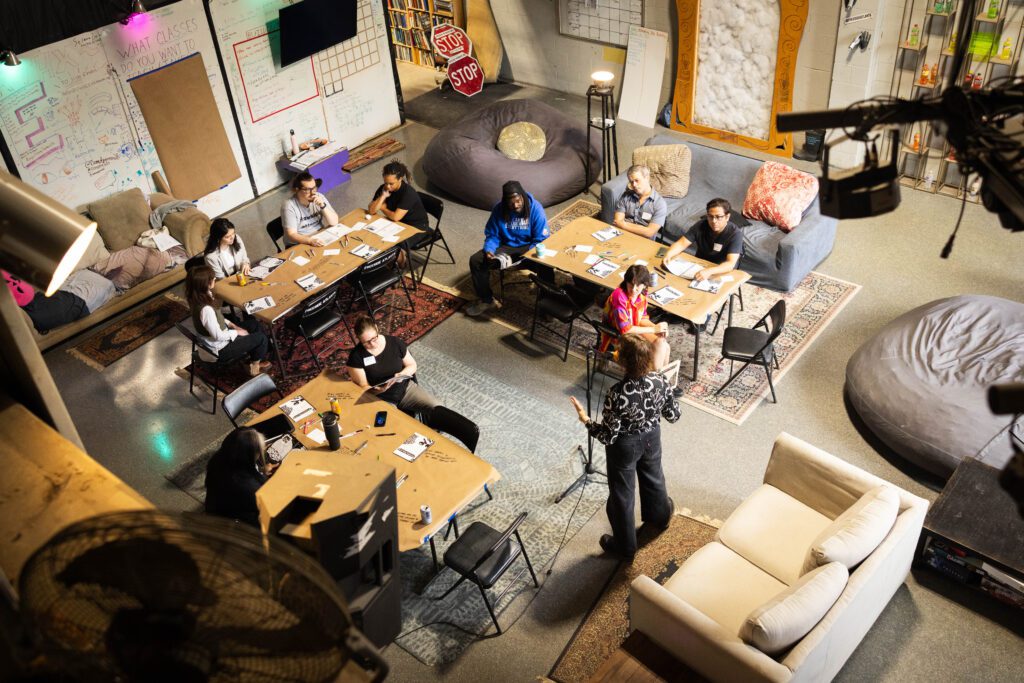
On April 25, 2026, Atlanta-based artists and creatives gathered at Freeside Atlanta to examine how AI is entering creative practice in uneven and sometimes contradictory ways. For some, it expands what is possible by speeding up processes, opening new forms of making, or creating new kinds of access. For others, it raises questions about authorship, labor, visibility, and who benefits from these systems. Rather than treating these as opposing positions, the gathering focused on the tensions between speed and care, access and extraction, possibility and risk—and on what those tensions mean for creative practice in Atlanta.
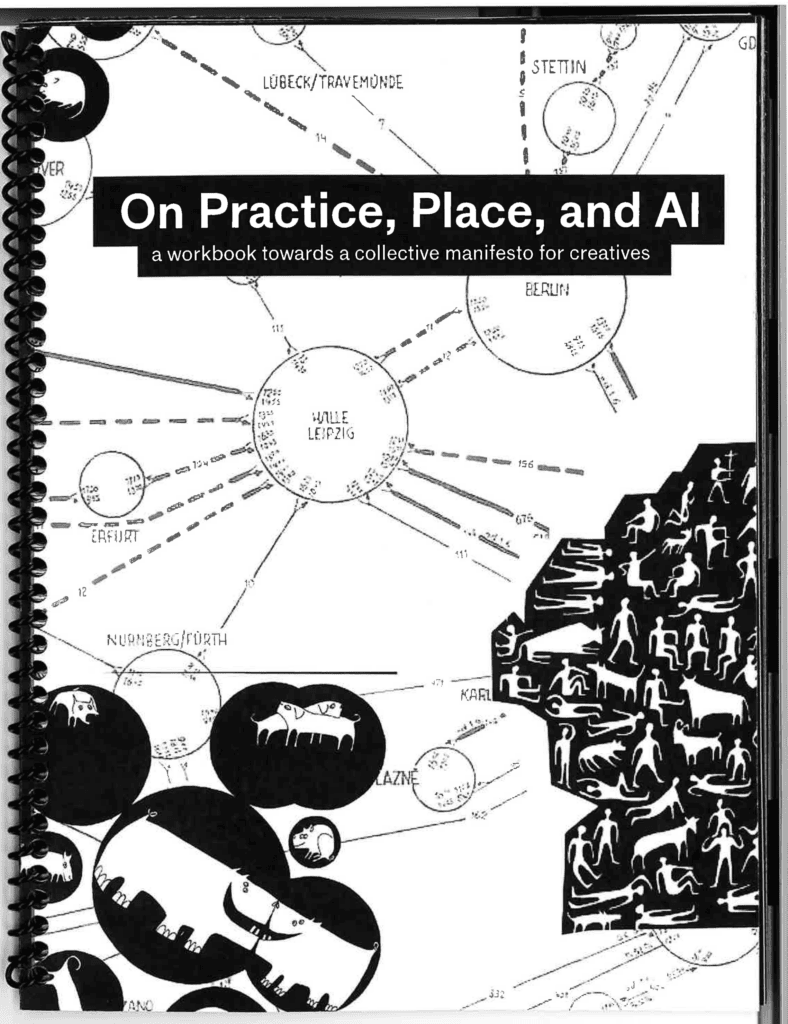
The Atlanta session was developed by Catherine Wieczorek and Carl DiSalvo and took place at Freeside Atlanta, a volunteer-built makerspace, in partnership with the Public Art Futures Lab and the AIAI Network. The session centered on On Practice, Place, and AI: A Workbook Towards a Collective Manifesto for Creatives, which uses a series of exercises to guide participants from reflection on their own creative practices, to discussion of where AI does or does not fit within that work, and finally to drafting a shared manifesto that sets out conditions for how AI might show up in their practice, if at all.
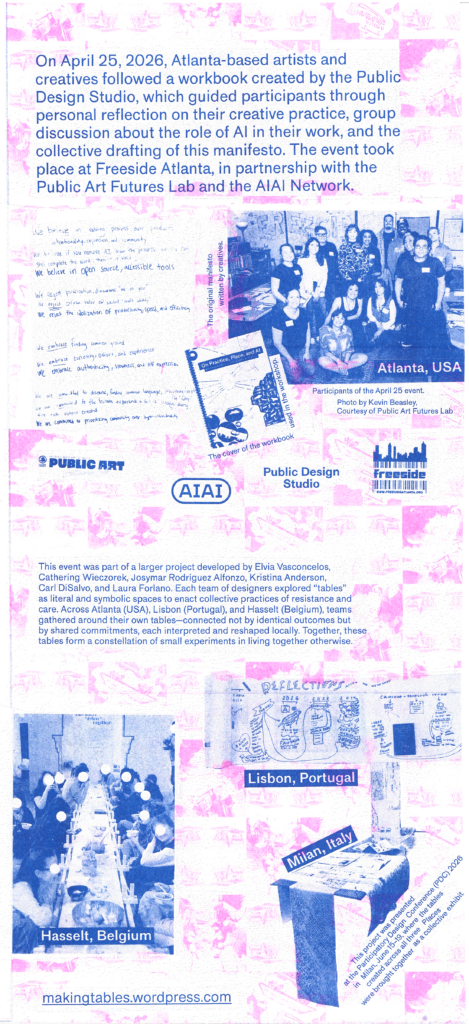
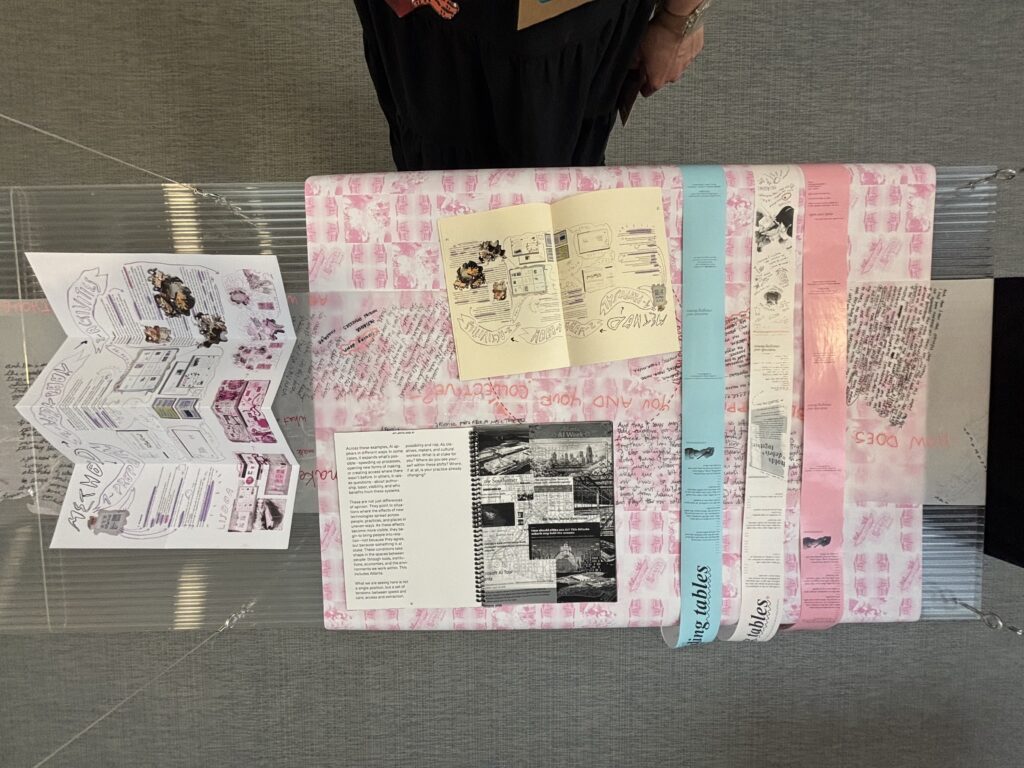
The workbook emerged from a larger collaborative project developed by Elvia Vasconcelos, Catherine Wieczorek, Josymar Rodríguez Alfonzo, Kristina Andersen, Carl DiSalvo, and Laura Forlano. Its first version was prototyped collaboratively by Vasconcelos, Wieczorek, and Rodríguez Alfonzo, with Wieczorek further adapting it for the Atlanta session. Across Atlanta (USA), Lisbon (Portugal), and Hasselt (Belgium), project teams explored “tables” as literal and symbolic spaces for collective practices of resistance and care. Each table took a different form, connected by a set of shared commitments that could be interpreted and reshaped in response to local contexts. Together, they form a constellation of small experiments in how people gather, deliberate, and imagine ways of living and working together. The workbook and photos from the Atlanta session were shown at the 2026 Participatory Design Conference in Milan as part of a wider exhibit on the project’s distributed tables.
Why a “table”?
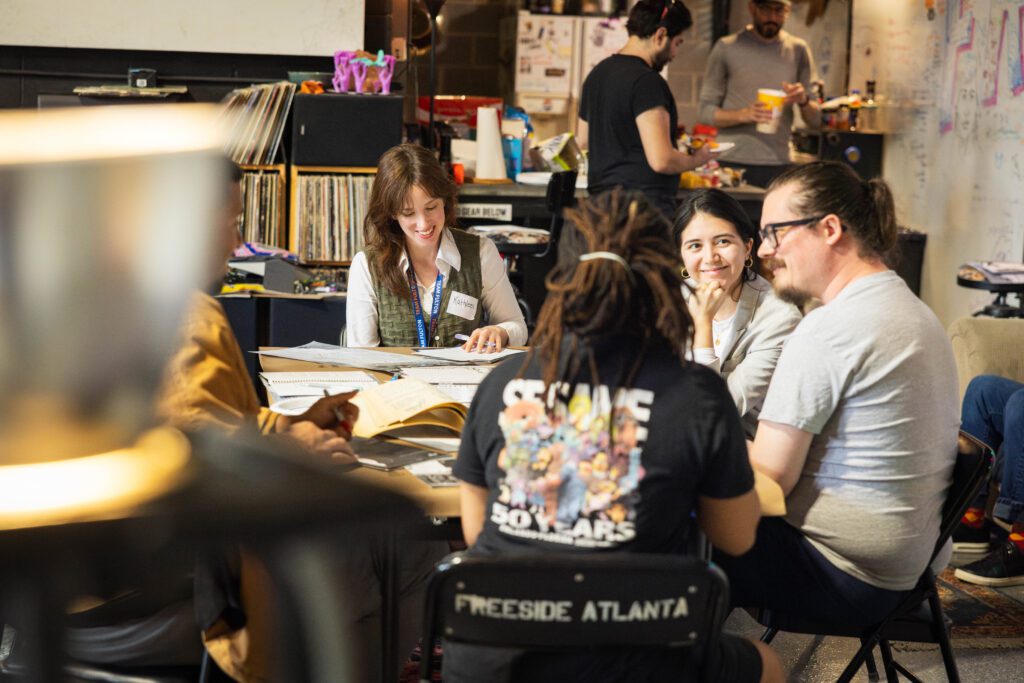
The table is both a place to gather and a way of organizing how people come together. Its material arrangement—who is invited, how it is set, what is placed on it, and what people are asked to do around it—shapes the relations that can form there. This project asks what it means to build the table together. Making at the table becomes a way to surface and negotiate the commitments of a group: what matters, where tensions lie, how responsibility is shared, and what forms of collective life participants want to sustain.
The table therefore functions as both site and practice. It holds space for different perspectives to encounter one another through shared activity, while making the conditions of that gathering available to question and remake. Each table can take a different form, but each offers a material way of asking how people might organize, care, disagree, and act together otherwise.
How the table worked
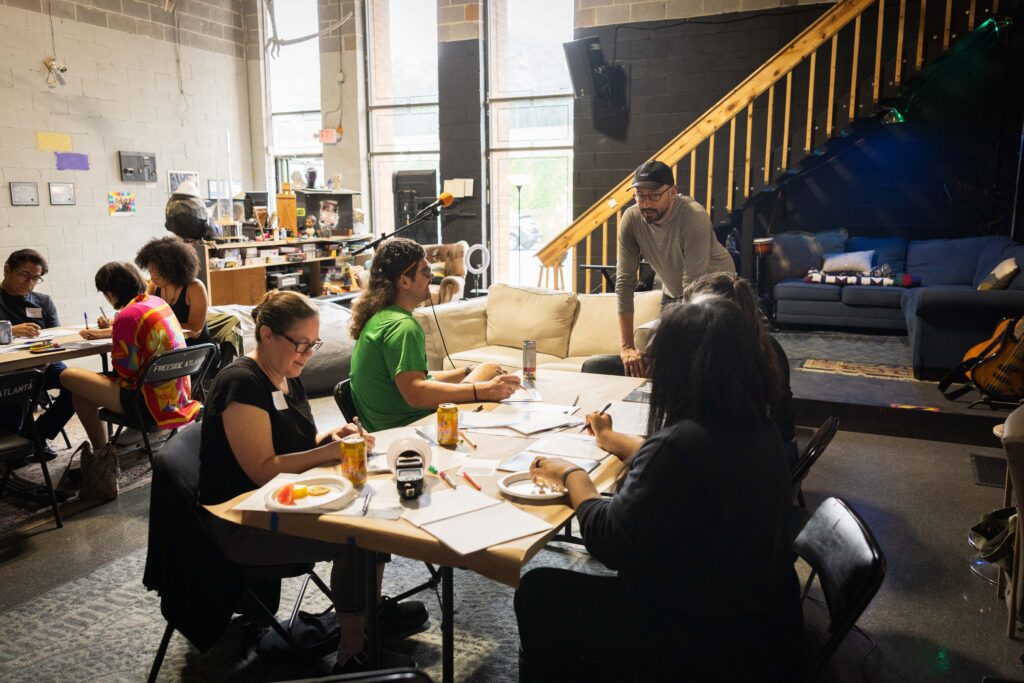
The Atlanta table used a printed workbook, On Practice, Place, and AI: A Workbook Towards a Collective Manifesto for Creatives. The workbook opened with a set of commitments that shaped how the group gathered before any making began:
- Make space for one another. Participation is actively invited, not assumed.
- Share responsibility. No one owns the table; voice, care, and decisions are continuously negotiated.
- Stay with difference through care. Conflict is treated as part of collective learning, not a reason to withdraw.
- Give something back. Each gathering shares a form others, elsewhere, can adapt or build on.
- Add your own.
From there, participants moved through a guided path:
- Map your practice. Using a fishbone diagram, each person named the materials, tools, processes, people, environments, and conditions (money, time, expectations, precarity) that shape their work. Then they indicated what felt essential, what took time to learn, what shapes the work most, and the one thing they would never want to lose.
- Reflect. Participants returned to their diagrams to mark what was shifting, where they felt friction, and where something felt newly possible.
- Share. Reading across example manifestos and each other’s statements, the group clarified positions by agreement and disagreement alike.
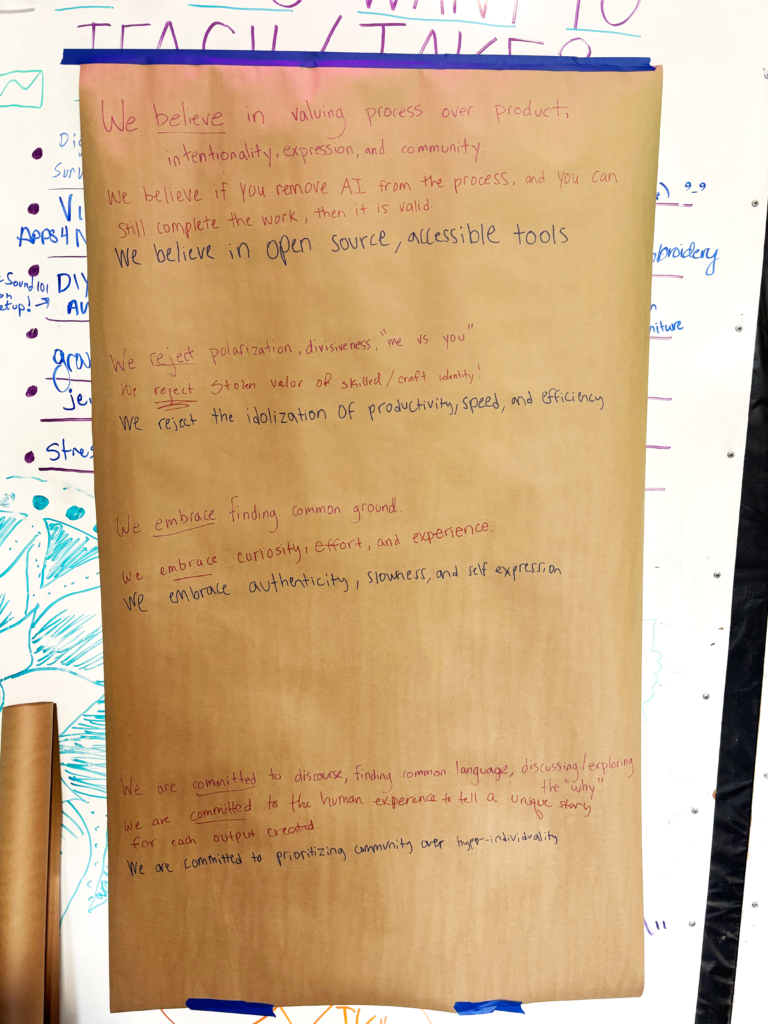
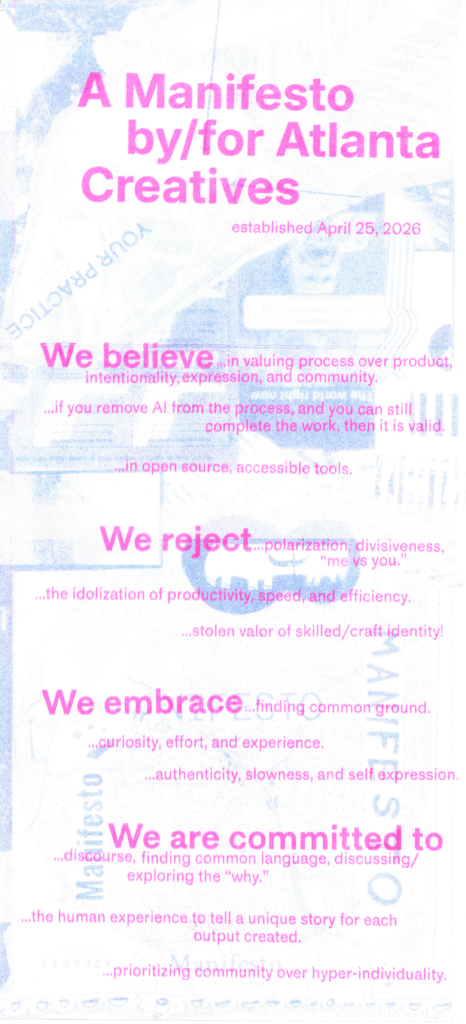
- Draft a manifesto. Together, participants wrote shared statements—We believe… We reject… We embrace… We are committed to…—and pooled them into one collective articulation.
Manifesto printing
Wieczorek took the manifesto drafted by participants and created a short poster. On the front, the manifesto is typeset just as participants drafted it; the reverse describes the project and its development. These prints were returned to the Public Art Futures Lab to share with participants and the greater Atlanta community.
PDC Places
At the 2026 ACM Participatory Design Conference, artifacts from each table were displayed together as part of the “PDC Places” exhibit. The exhibition brought together 12 situated gatherings from different contexts, each grounded in local relations, urgencies, and forms of knowledge. It held these projects in dialogue without treating them as a unified model of participation, while also foregrounding the unequal conditions that shape who is able to take part.
Concept, Design, and Event: Catherine Wieczorek & Carl DiSalvo
Project Partners: The event took place at Freeside Atlanta, a nonprofit makerspace built entirely by volunteers, alongside collaborators and sponsors the Public Art Futures Lab and the Atlanta Interdisciplinary Artificial Intelligence Network.
Riso Printing: Sarah Lawrence
Photography: Kevin Beasley
Related Publications:
Vasconcelos, E., Wieczorek, C., Rodríguez Alfonzo, J., Andersen, K., DiSalvo, C., & Forlano, L. (2026, June). Make Your Own Table: Places of Collective Making. In Proceedings of the 19th Participatory Design Conference 2026, Vol. 3: Workshops, Situated Actions, and PDC Places (pp. 154–156).